Monday, 27 June 2011

new architecture

© Emilio Collavino
Photographer Emilio Collavino recently shared these photographs of Frank Gehry’s New World Center in Miami, Florida. Part of the New World Symphony America’s Orchestral Academy, the music education and performance facility is the first puporse-built home for the New World Symphony founded by artistic director Michael Tilson Thomas. The New World Center opened its doors to the public in January of this year.


© Emilio Collavino
The rectangle shaped white building expresses Gehry’s well known bends and folds within its interior – glimpses of which are visible through the main entrance east facade 80 foot high glass curtain wall.

© Emilio Collavino

© Emilio Collavino

- © Emilio Collavino
- © Emilio Collavino

- © Emilio Collavino

- © Emilio Collavino

- © Emilio Collavino

- © Emilio Collavino

- © Emilio Collavino

- © Emilio Collavino
- © Emilio Collavino

- © Emilio Collavino

- © Emilio Collavino

- © Emilio Collavino
- © Emilio Collavino

- © Emilio Collavino

- © Emilio Collavino
- © Emilio Collavino
Sunday, 12 June 2011
JAKARTA --India's Essar Group has its eye on two coal-bed methane blocks in Indonesia, and continues to look for investment opportunities in mining and power generation in the South East Asian country.
The group has submitted a bid for one coal bed and is conducting a joint study for the other, said K.B. Trivedi, president director of PT Essar Indonesia, on the sidelines of the World Economic Forum on East Asia.
The two blocks are located in Kalimantan, which is in the Indonesian part of Borneo Island. Essar's business operations range from energy to telecommunications.

 The move reflects growing interests in Indonesia energy sectors from Essar and other Indian companies. A handful of Indian companies, including Essar, have in recent years acquired coal mines in Indonesia to help secure India's rapidly growing demand for energy.
Essar last year bought coal mines, with mineable reserves of 64 million tons, in Kutai, East Kalimantan.
"We continue to look for other investment in the oil and gas, mining sectors, and power generations (in Indonesia)," said Essar Group's Chief Executive Prashant Ruia.
Apart from Indonesia, Essar will evaluate opportunities as they come up, Mr. Ruia added. He mentioned the African continent and Australia as other potential regions where the company will look to invest.
In the short term, however, Mr. Ruia said the company is focusing on existing projects at its home country, such as power plants and expansion in crude oil refining.
"Our focus in the next one year is to get these projects completed and then look at future development from there," he said.
He said that the company's imported coal requirement up to 2015 is around 25 tons of varying calorific from 4,800 kcal/kilogram to 6,400 kcal/kg.
Touching on the problem surrounding payment for crude oil imports from Iran, Mr. Ruia reassured that the company, and other Indian importers, continue to get crude supply from the Middle Eastern country.
India in late May said it would continue discussions with Iran on settlement of payments for crude oil purchases, after talks between officials from both the countries on ending an impasse over payments proved inconclusive.
India's crude supplies from Iran are under threat as the two countries are trying to negotiate a new payment mechanism after the Reserve Bank of India stopped payments through the Asian Clearing Union in December, which the U.S. says is opaque and could be used by Tehran to finance its alleged nuclear weapons program.
But Mr. Ruia said crude oil from Iran is "a small percentage of the total crude imports," and added that "we continue to import from South America, from Europe, Africa and other Middle Easter countries."
Iran is the second-largest crude oil supplier to India after Saudi Arabia and accounts for about 13%-14% of the country's oil imports.
The group has submitted a bid for one coal bed and is conducting a joint study for the other, said K.B. Trivedi, president director of PT Essar Indonesia, on the sidelines of the World Economic Forum on East Asia.
The two blocks are located in Kalimantan, which is in the Indonesian part of Borneo Island. Essar's business operations range from energy to telecommunications.
Reuters

An Essar Oil refinery in Gujarat. The company has submitted a bid for a coal bed in Indonesia, however, it is currently focusing on its existing projects such as power plants and expansion in crude oil refining in India.
Essar last year bought coal mines, with mineable reserves of 64 million tons, in Kutai, East Kalimantan.
"We continue to look for other investment in the oil and gas, mining sectors, and power generations (in Indonesia)," said Essar Group's Chief Executive Prashant Ruia.
Apart from Indonesia, Essar will evaluate opportunities as they come up, Mr. Ruia added. He mentioned the African continent and Australia as other potential regions where the company will look to invest.
In the short term, however, Mr. Ruia said the company is focusing on existing projects at its home country, such as power plants and expansion in crude oil refining.
"Our focus in the next one year is to get these projects completed and then look at future development from there," he said.
He said that the company's imported coal requirement up to 2015 is around 25 tons of varying calorific from 4,800 kcal/kilogram to 6,400 kcal/kg.
Touching on the problem surrounding payment for crude oil imports from Iran, Mr. Ruia reassured that the company, and other Indian importers, continue to get crude supply from the Middle Eastern country.
India in late May said it would continue discussions with Iran on settlement of payments for crude oil purchases, after talks between officials from both the countries on ending an impasse over payments proved inconclusive.
India's crude supplies from Iran are under threat as the two countries are trying to negotiate a new payment mechanism after the Reserve Bank of India stopped payments through the Asian Clearing Union in December, which the U.S. says is opaque and could be used by Tehran to finance its alleged nuclear weapons program.
But Mr. Ruia said crude oil from Iran is "a small percentage of the total crude imports," and added that "we continue to import from South America, from Europe, Africa and other Middle Easter countries."
Iran is the second-largest crude oil supplier to India after Saudi Arabia and accounts for about 13%-14% of the country's oil imports.
Earthquakes rock Christchurch, New Zealand
June 13, 2011 2:08 a.m. EDT
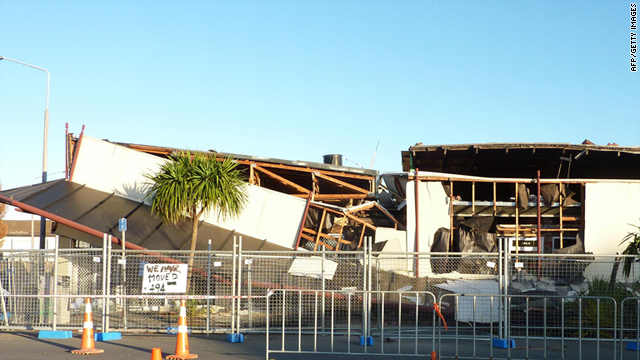
A general view shows quake-damaged buildings in Christchurch, New Zealand, on Monday.
STORY HIGHLIGHTS
- Three quakes strike near Christchurch within two hours
- Two of the quakes have magnitudes of at least 5.0
- Power is out and phone lines are down in Christchurch, a resident says
- A 6.3-magnitude temblor struck the same area in February, killing more than 180 people
"Everyone is on edge here anyway," said Rhys Taylor, who said he could hear sirens and see helicopters flying over Christchurch. "Obviously, power's out -- sort of all over the city at the moment -- and phone lines are down."
Police evacuated sections of the city's central business district after reports of a possible gas leak, police said. Several bridges in the city were closed as a precaution.
"It was quite an exciting ride," Christchurch Police Acting Inspector Murray Hurst told CNN after the first quake, adding that there was some damage caused by the quake and a few injuries that were not life-threatening.
The first quake -- a magnitude 5.2 -- was centered 9 kilometers (5 miles) east-southeast of Christchurch at a depth of 11 kilometers (6.8 miles), according to USGS. The quake took place at 1 p.m. Monday.

 Two quakes rock New Zealand
 And at least one smaller quake followed. A magnitude 4.6 quake struck at 2:40 p.m. about 11 kilometers (6 miles) east of Christchurch and at a depth of 12.5 kilometers (7.8 miles), according to the USGS.
The quakes came nearly four months after a 6.3-magnitude temblor struck the same area, killing more than 180 people.
FUNCTIONING OF HUMAN BRAIN
How the human brain works? Why are some people insane in the brain?
Answer:
Cognitive modules
The human brain works by activating thought modules (cognitive modules). Examples of cognitive modules:
- The modules controlling your hands when you ride a bicycle, to stop it crashing by minor left and right turns.
- The modules which allows a basket-ball player to accurately send the ball into the basket.
- The modules which recognized hunger and says that you need food.
- The modules which cause you to appreciate a beautiful flower, painting or person.
- The modules which cause some humans to be jealous of their partners' friends.
- The modules which computes the speeds of other vehicles and tells you if you have time to cross before the other car arrives.
- The modules which tell you to look both to the right and to the left before crossing a street.
- The modules which cause parents to love and take care of their children.
- The sex drive modules.
- The fight or flight selection modules.
Learned or inherited
Some of these modules are partly based on genetic inheritance, but also the inherited modules can be modified by learning. All you learn, in your childhood, and as an adult, will add new cognitive modules to your brain. An adult human has millions of cognitive modules. The human species is unique in its capability to develop and modify cognitive modules by learning. Thus, the human species is successful because it is not so much controlled by instinct (genetic modules) and that it can modify or replace genetic modules by learned modules.
Selecting the right cognitive modules
How, then, does the human brain select the right module to apply to a certain issue? This can be explained by an analogy with a piano. A piano has a number of strings, one for each tone. If you let a loudspeaker play a single tone loudly, then the corresponding piano string will begin to vibrate. Other piano strings corresponding to close matches, and to overtones of the played tone, will also start to vibrate, but to a less extent. All the piano strings receive the sound, but only those that match the sound will begin to vibrate. Thus, all piano strings test the sound at the same time.
In a similar way, when meeting a situation, this situation will simultaneously test many cognitive modules in the brain. To test manu modules at the same time is known as "parallel processing" and is something which the brain is much better at than computers. But of all tested modules, only those which fit the situation best, are those which are most closely matched with the situation to be managed. The brain then has a selection mechanism, where the cognitive module which is most strongly activated takes over and is used as a model for how to handle the new situation. Examples of this selection mechanism is when you are feeling pain in different parts of the body at the same time, you are only conscious of the strongest of the pains. In the same way, lots of modules may react to your situation, but only one or two of the strongest will make its way up to the conscious mind. The human brain contains millions of billions of synaptic connections, in which the cognitive modules are stored. This vast size, and the capability to rapidly find appropriate moduels in this large storage, is central to human intelligence.
Difference between the human brain and computers
Note that this is very different from the way a normal computer functions. Few computers have this facility of activating and matching millions of cognitive modules and selecting the appropriate one in a new situation. Especially the human capability to recognize cognitive modules which are in some way similar, but not identical, to a new situation, is unique for humans. Computers are good at finding identical situations, but not good at finding similar but not identical situations.
Psychic disorders
Personality and psychic disorders can then easily be explained by the same model. Such disorders are simply dysfunctional cognitive models. People who have been involved in an airplane accident, may develop a cognitive module which causes them to shy traveling by air. Such cognitive modules are named "phobias". More.
A person may have developed cognitive modules which were appropriate to handle relations with some other people, for example close family members. They may then apply such modules to other people, even when they are not appropriate. This is in psychology terminology called transference, and is one of the most common causes of neurosis. Obsessive Compulsive Disorder (OCD) means that some cognitive modules, for example involved with washing, are stimulated too much.
Most law-abiding people have cognitive modules which stop them from committing crimes. Criminals have different modules, causing criminal behaviour.
Paranoia and paranoic personality disorders are cognitive modules which exaggerate the idea that other people are out to get you.
Sigmund Freud's theory of sublimination said that cognitive modules for some activities, such as sex, may incorrectly be applied in cases where they are not suitable. Freud also introduced the idea of the unconscious, by which is meant cognitive modules, where a person is not aware of the initial cause of these modules, and may then use them inappropriately.
Treatment of psychic disorders
The aim of psychotherapy is the modification or replacement of inappropriate cognitive modules (cognitive-behavioural therapy). Important is also training in how to control inappropriate reactions caused by inappropriate cognitive modules. It is easier to do this if you are aware of your inappropriate cognitive modules, thus, understanding and recognizing these modules is also central to psychotherapy. The psychodynamic school of psychotherapy puts much efforts into recognizing how you learned inappropriate modules as a child, while the gestalt school of psychotherapy puts more effort into understanding how the inappropriate modules work in the present.
Certain psychic disorders, such as schizophrenia, depression and OCD, seem to be related to incorrect triggering and emphasis on certain modules. While psychotherapy can help also for such disorders, medicines which modify these incorrect triggerings are also important in the treatment of such disorders. The best effect is often achieved by a combination of medicines and psychotherapy. Superstition and prejudices
A problem with the human dependence on use of stored cognitive modules is that when such modules are inappropriate or out of date, they are the cause of superstition, prejudice and unwillingness to accept changes.
There is also a problem in that humans very easily construct new cognitive modules which are inappropriate. To understand the mechanism behind this, the result of a psychological experiment can be used. In this experiment, a machine was constructed which generated a random series o bits, 0 or 1. The bits were generated so that on average, one third was a 0 and two thirds was a 1. A test person was then asked to guess, before the display of the next bit, whether that bit would be 0 or 1. The test person would also get paid, with higher payment the more often he/she guessed right. Since the bits were random, there was no chance of really guessing what the next bit would be. The optimal strategy for maximising the score would then to always guess at a 1. This would give a score of 66.7 % right. However, very few of the test persons ended up using this optimal strategy. Most of the test persons developed more or less complex rules for whether the next bit would be a 0 or a 1, giving on average a 55.6 % score, .
What this experiment indicates, is that humans, when confronted with a complex reality, tend to construct complex explanations rather than accept that the reality contains a random element which they cannot predict. In real life, this tendency means that people will often guess at explanations which are incorrect, when confronted with a complex reality. Example of such incorrect deductions are beliefs like "Moslems were guilty of the 9/11 attacks, killing 2819 people, thus all moslems are evil" or "This homeopatic medicine makes me better".
The reason why the human mind works in this way, is probably that in many cases, it is useful to build new or revised cognitive modules to handle new kinds of situations. The tendency to build new or revised cognitive modules is thus in most cases a good strategy, and it may be more useful for a person to sometimes generate false cognitive modules than to not try to find explanations for what happens in life.
Group support
Another very common human tendency is to group other people into different kinds of groups, and then to like and support people who belong to the same group as oneself. This tendency can manifest itself as support for people believed to belong to the same ethnic group, religion, or speaking the same language. Even within a language, there are sublanguages, such as the language used my medical doctors when communicating with each other. A person belonging to such a group, such as a medical doctor, will be more positive to another person capable of using the medical language. This tendency is probably partly genetic, and it may have developed in a human life where people belonged to many small tribes and had a need to support members of their own tribe and be suspicuous of members of other tribes.
Are cognitive modules intelligent?
Note that cognitive modules can be intelligent or dumb, rational or emotional, effective or ineffective, suitable or unsuitable. Psychic illness occurs when a person has some cognitive modules which are inappropriate and which dominate too much.
Some people say that human thinking can be categorized into rational thinking and emotional thinking, with an implicit assumption that rational thinking is in some way better or more effective. However, cognitive modules combine rational and emotional thinking, and many very important and appropriate modules are highly emotional, for example the module which causes people to care for and protect children. A better way of categorizing cognitive modules is as appropriate and inappropriate, rather than as rational and emotional modules. world shortest man
Filipino teen declared world's shortest man
Junrey Balawing stands next to a rooster during a photo taking session with the Guinness World Records team in Sindangan, Zamboanga del Norte in southern Philippines June 11, 2011.
Credit: Reuters/Erik de Castro
SINDANGAN,Phillipines |
SINDANGAN,Phillipines (Reuters Life!) - Junrey Balawing, from a remote town in the southern Philippines, stands just under two feel tall and has been officially declared the World's Shortest Man by Guinness World Records.Balawing, who just turned 18, is 23.5 inches tall, succeeding previous title holder Khagendra Thapa Magar from Nepal, who is 26 inches tall.
A team from Guinness World Records made the announcement in the remote town of Sindangan, where Balawing lives, on his 18th birthday on Sunday. Claimants for the title must be at least 18 years old.
"We are happy on this day. We are proud of Junrey," his mother Concepcion said.
The Guinness team, led by Guinness World Records editor-in-chief Craig Glenday, measured Balawing both vertically and horizontally before declaring him the world's shortest man and handing him a certificate.
Balawing's father said his son, the oldest of four children, stopped growing in his first year. His speech is also stunted and his conversations are limited to short phrases.
Balawing mostly stays at home, needing assistance to move around. His condition has prevented him from attending school.
While the award does not come with a cash prize, Glenday said the team hopes that publicising Balawing's case will draw the attention of medical experts who may be able to help him. Local medical practitioners have not been able to explain his growth disorder.
"The previous record holder had been given medical care... He even had free surgery provided by the U.S.A. So there are benefits to being a record holder," Glenday said.
"We feel for him because of his size. Obviously, being that size, it's quite a compromised life. We hope that by publicising his case, medical practitioners will pay attention."
A smiling Balawing celebrated his 18th birthday with balloons and a cake.
Subscribe to:
Posts (Atom)